

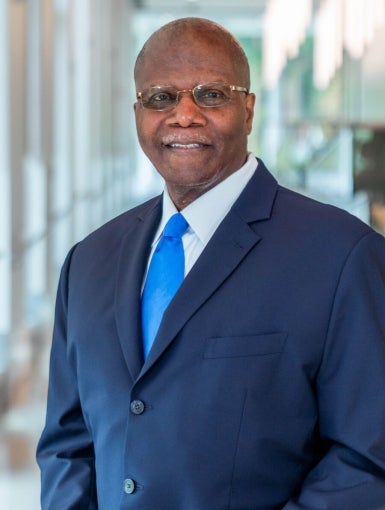
Ron Moultrie is a distinguished senior fellow in Executive Programs at the School of Public Policy and a nationally recognized leader in intelligence, security and emerging technologies. As former under secretary of defense for intelligence and security, he has advised senior U.S. leaders on global threats, cybersecurity and artificial intelligence (AI). In this interview, Moultrie reflects on the evolving national security landscape and the role universities play in preparing the next generation of public sector leaders.
Having led some of the nation’s most critical intelligence and security organizations, what are the biggest national security challenges on the horizon?
Global events involving U.S. interests and personnel, such as the recent activity in Venezuela, are always the preeminent national security challenge. Our policymakers should ensure that our intelligence and security personnel have the resources, including talent and authorities to fully understand long-standing and nascent challenges and threats while remaining current on the latest technological advances.
Given the rapid shifts in cybersecurity, AI, data analytics and emerging technologies across government, how should universities and public policy programs update their training to prepare students for this rapidly changing security landscape?
To support student needs, university and public policy programs will need to establish a foundational core curriculum in cybersecurity, AI, data analytics, etc., taught by world-class faculty. Enlisting the support of industry, government and private sector talent with operational knowledge of how emerging technology is evolving will be critical. These practitioners will be best able to prepare students for scenarios that they will likely encounter in the real-world.
Your previous roles spanned operational, technological and strategic leadership. Which skills or mindsets are most valuable for young professionals to develop who hope to work across multiple sectors?
Tomorrow’s future professionals will need a hybrid of skills, e.g. in operations, technology and strategic leadership, to be successful. A life-long-learner will strive to be very proficient in a core skill while also acquiring a high-level understanding of colleagues’ work areas. A risk taker will be willing to explore new sectors which usually will be a growth experience. Coupling these two mindsets together can be an unbeatable combination for those who are highly-motivated to be a success.
As AI, quantum computing and next-generation communications advance, what approaches can help policymakers balance innovation with responsible, ethical and secure deployment of these technologies?
While most policymakers understand that disruptive technologies such as AI, quantum computing and next-generation communications will be revolutionary to how we live in the future, they may not fully comprehend the inherent challenges that these advancements might bring about. A prudent approach would be to incrementally examine, thoroughly understand and if necessary, establish guardrails that ensure the ethical and safe use of these technologies. Policymakers will not be able to control how these technologies are proliferated by other countries so there must also be a balance between not harming business interests while ensuring that our most vulnerable citizens are protected.
With government, industry and academia increasingly interconnected, how can these sectors collaborate more effectively to strengthen U.S. security and global competitiveness?
Public-private partnerships are needed now more than ever. In addition to greater transparency among all sectors, the robust exchange of personnel across these environments would greatly enhance collaboration. The establishment of chairs, faculty positions and fellowships in colleges and universities and the creation of more internships, co-ops, apprenticeships and part-time jobs in industry would bolster and strengthen these vital relationships. Establishing these positions in tech-rich agencies, industry and academic institutions would tremendously strengthen national security and further our competitive standing in the world. Lastly, if properly implemented, these exchanges would serve as a mutual talent pipeline for all involved.
As a proud Terp whose education started here at the University of Maryland, what drew you to the School of Public Policy now? How do you view the School’s role in preparing leaders for the public policy and national security challenges ahead?
As a proud UMD alum, the opportunity to give back to a University that has given me so much is a superb fit. It is also an opportunity to serve in one of our nation’s top policy schools. SPP is located at the very heart of where policymakers and their policy-supporting agencies and departments reside, so it makes perfect sense for me to remain at the fulcrum of where policy and academia come together. SPP has a very supportive dean, tremendous faculty, access to current and former policymakers and an eager student body. This is a unique formula that should be able to support our nation’s policymaking community for decades to come.